



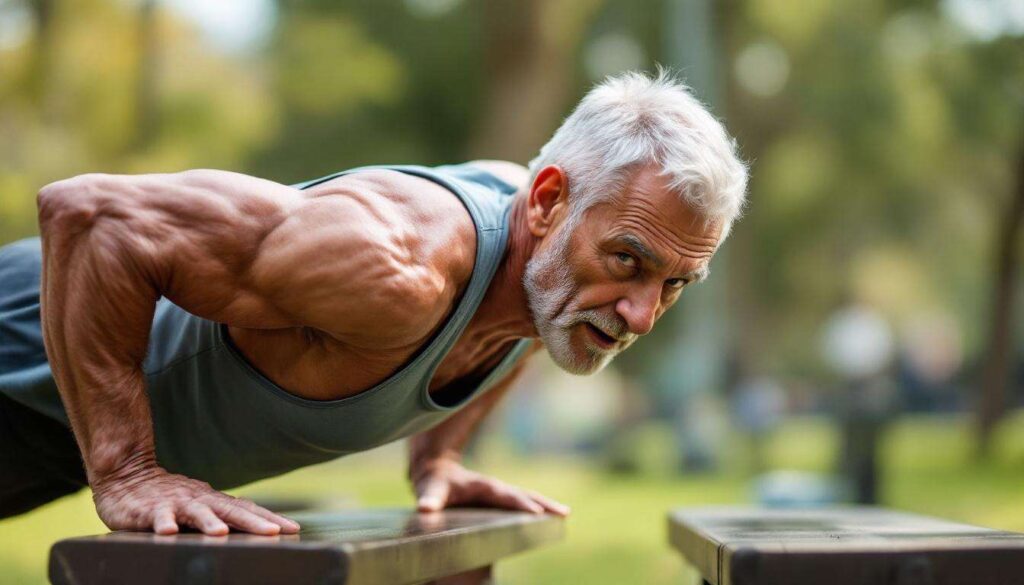
Maintaining upper-body strength becomes increasingly vital as we age, yet many people over 55 find traditional weightlifting routines challenging or even risky. The good news is that bodyweight exercises offer a remarkably effective alternative, often delivering superior results whilst minimising joint stress and injury risk. These movements harness your own mass as resistance, creating functional strength that translates directly into daily activities. For those seeking to rebuild or maintain upper-body power without gym equipment, five specific bodyweight exercises stand out for their efficiency and safety profile.
The importance of bodyweight exercises after 55
Why bodyweight training suits mature bodies
Bodyweight exercises present unique advantages for individuals over 55 that conventional weight training cannot match. These movements allow for natural range of motion whilst reducing the compressive forces on joints that often accompany heavy lifting. The adaptability of bodyweight training means progression occurs gradually, respecting the body’s changing capabilities without forcing unnatural loads onto ageing connective tissues.
Key benefits for upper-body development
Research consistently demonstrates that bodyweight training offers multiple benefits specifically relevant to older adults:
- Enhanced proprioception and balance through integrated movement patterns
- Reduced injury risk compared to external weights
- Improved bone density through progressive mechanical stress
- Greater functional strength applicable to daily tasks
- Cost-effective training requiring minimal equipment
The compound nature of bodyweight movements engages multiple muscle groups simultaneously, creating efficient training sessions that respect time constraints whilst delivering comprehensive results. This holistic approach proves particularly valuable for maintaining independence and quality of life.
Physiological considerations after 55
| Physiological factor | Impact on training | Bodyweight advantage |
|---|---|---|
| Reduced tendon elasticity | Increased injury susceptibility | Controlled, scalable resistance |
| Decreased muscle mass | Lower baseline strength | Progressive self-regulation |
| Joint wear | Pain during loaded movements | Natural movement patterns |
Understanding these physiological realities helps explain why bodyweight training often produces faster, more sustainable strength gains for mature individuals. The body responds positively to movements it recognises as functional rather than artificial.
With this foundation established, exploring specific exercises reveals how simple movements can transform upper-body strength.
Push-ups: a classic revisited
Proper form and technique
The push-up remains unmatched for developing chest, shoulder, and tricep strength whilst engaging core stabilisers. Proper execution requires hands positioned slightly wider than shoulder-width, body forming a straight line from head to heels, and controlled descent until the chest nearly touches the ground. The key lies in maintaining tension throughout the entire movement rather than rushing through repetitions.
Modifications for different fitness levels
Adaptability makes push-ups ideal for those over 55. Wall push-ups provide an excellent starting point, progressing to incline variations using a bench or step. As strength develops, standard floor push-ups become achievable, with decline variations offering further challenge. Each modification maintains the fundamental movement pattern whilst adjusting resistance to match current capabilities.
Muscle groups targeted
- Pectoralis major and minor (chest)
- Anterior deltoids (front shoulders)
- Triceps brachii (back of upper arms)
- Serratus anterior (side chest)
- Core stabilisers (abdominals and lower back)
The integrated activation of these muscle groups creates functional strength patterns that directly support everyday activities like pushing doors, lifting objects, or rising from the floor. This practical application distinguishes bodyweight training from isolated machine exercises.
Building upon pushing strength, the next movement focuses on different muscle groups through a complementary action.
Dips: developing tricep and shoulder strength
Setting up for safe execution
Dips demand careful attention to setup and form, particularly for older adults. Using parallel bars, a sturdy bench, or even two chairs of equal height, the movement involves supporting bodyweight on extended arms before lowering the body in a controlled manner. Shoulder positioning proves critical: keeping shoulders down and back prevents impingement whilst maximising tricep engagement.
Progression strategies
Beginning with bench dips allows gradual strength development. Feet positioned on the ground reduce resistance, whilst elevating feet increases difficulty. As confidence grows, parallel bar dips offer greater range of motion and muscle activation. The progression should feel challenging yet sustainable, avoiding the temptation to advance too quickly.
Common mistakes to avoid
| Mistake | Consequence | Correction |
|---|---|---|
| Excessive forward lean | Shoulder strain | Maintain upright torso |
| Descending too deeply | Joint stress | Stop at 90-degree elbow bend |
| Flared elbows | Reduced tricep activation | Keep elbows close to body |
Mastering dips creates remarkable tricep development often surpassing what isolation exercises achieve. The functional strength gained translates directly into improved ability to push oneself up from chairs or the floor.
Whilst pushing movements build front-body strength, the next exercise addresses the equally important posterior chain.
Pull-ups: engaging the back and biceps
Why pull-ups challenge and reward
Pull-ups represent perhaps the most demanding yet rewarding bodyweight exercise for upper-body development. The movement requires lifting the entire body mass against gravity, creating intense stimulus for back and arm muscles. For those over 55, this exercise builds critical pulling strength necessary for maintaining independence in activities like carrying shopping or climbing.
Assisted variations for beginners
Few people can perform unassisted pull-ups immediately, making progression strategies essential. Resistance bands looped over the bar provide adjustable assistance, whilst inverted rows using a low bar offer a horizontal pulling alternative. Negative pull-ups, where one jumps to the top position and slowly lowers down, build eccentric strength effectively.
Comprehensive muscle activation
- Latissimus dorsi (large back muscles)
- Rhomboids (upper back)
- Trapezius (neck to mid-back)
- Biceps brachii (front of upper arms)
- Forearm flexors (grip strength)
- Core stabilisers (maintaining body position)
The multi-joint nature of pull-ups creates strength that extends beyond isolated muscle groups, developing coordination and body awareness alongside raw power. This comprehensive activation explains why pull-ups produce such dramatic improvements in overall upper-body capability.
Having addressed major pushing and pulling movements, attention now turns to stabilisation exercises that support all other upper-body activities.
Dynamic planking: strengthening the scapular belt
Beyond static holds
Traditional planks build endurance, but dynamic variations create strength gains more applicable to functional movement. Shoulder taps, plank reaches, and plank rotations challenge the scapular stabilisers whilst maintaining core engagement. These movements develop anti-rotational strength crucial for preventing injury during daily activities.
Specific dynamic variations
Incorporating movement into planking positions transforms a simple hold into a comprehensive upper-body strengthener:
- Shoulder taps: alternately touching opposite shoulders whilst maintaining stable hips
- Plank walks: moving hands forward and backward or side to side
- Plank rotations: twisting into side plank positions
- Plank reaches: extending one arm forward whilst balancing
Scapular health and function
The scapular belt comprises muscles connecting the shoulder blades to the spine and ribcage. These often-neglected muscles provide the foundation for all upper-body movements. Dynamic planking specifically targets the serratus anterior, rhomboids, and lower trapezius, creating shoulder stability that prevents common age-related issues like rotator cuff problems.
With stabilisation addressed, the final exercise combines all previous elements into one comprehensive movement.
Burpees: a comprehensive upper-body exercise
The full-body integration
Burpees synthesise pushing, stabilising, and dynamic movement into one remarkably efficient exercise. The standard burpee involves dropping into a plank position, performing a push-up, jumping feet forward, and standing up. This sequence engages virtually every upper-body muscle group whilst elevating heart rate and building cardiovascular fitness alongside strength.
Age-appropriate modifications
Standard burpees may prove too demanding initially, but modifications maintain effectiveness whilst reducing impact:
| Modification | Difficulty level | Key benefit |
|---|---|---|
| Step-back burpees | Beginner | Eliminates jumping |
| Elevated burpees | Intermediate | Reduces range of motion |
| Standard burpees | Advanced | Maximum intensity |
Why burpees accelerate strength gains
The metabolic demand of burpees creates an environment conducive to rapid strength development. The combination of resistance training and cardiovascular stress triggers hormonal responses that support muscle growth and fat loss. For those over 55, this efficiency proves invaluable, delivering maximum results from minimal time investment.
Regular burpee practice develops explosive power alongside endurance, creating functional fitness that translates into improved quality of life. The movement’s complexity also challenges coordination and balance, addressing multiple aspects of physical fitness simultaneously.
These five bodyweight exercises offer a complete approach to upper-body strengthening for individuals over 55. Each movement addresses specific muscle groups whilst contributing to overall functional fitness. The beauty of bodyweight training lies in its accessibility and adaptability, allowing progression at individual pace without expensive equipment or gym memberships. Consistency proves more valuable than intensity, with regular practice yielding remarkable improvements in strength, stability, and confidence. By incorporating these exercises into a balanced routine, mature adults can build and maintain upper-body strength that supports independence and enhances daily life for years to come.