



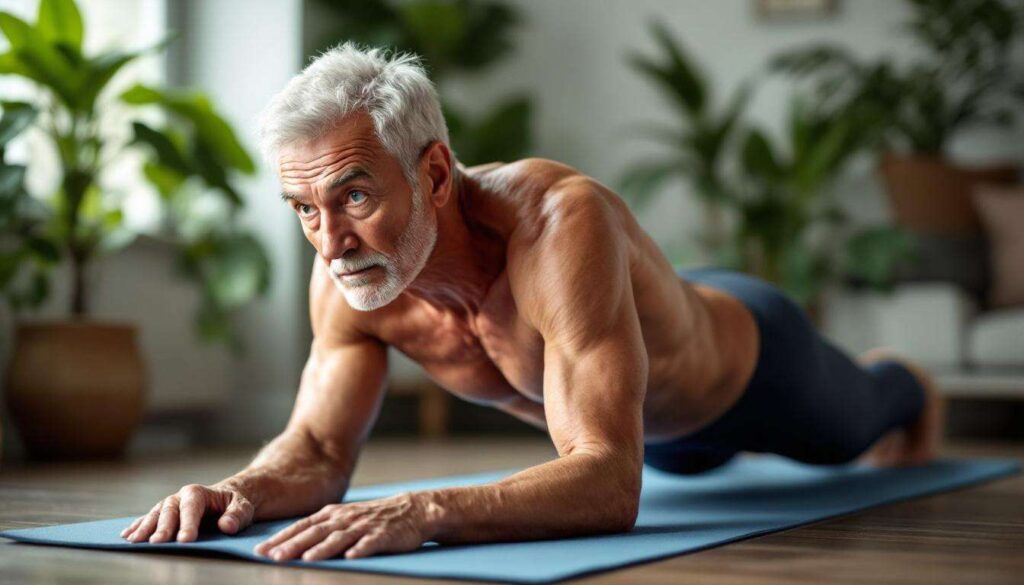
Core strength remains a crucial indicator of overall fitness and functional ability as we age. For individuals over 60, maintaining a strong core can mean the difference between independence and reliance on others for daily activities. The plank exercise has emerged as one of the most effective ways to assess and develop core stability, requiring no equipment whilst engaging multiple muscle groups simultaneously. Understanding how long one should be able to hold this fundamental position provides valuable insight into physical conditioning and potential areas for improvement.
What is a plank and why is it important after 60 ?
Understanding the plank exercise
A plank is an isometric core exercise where the body maintains a straight position supported by the forearms and toes. The exercise requires holding this position without movement, engaging the abdominal muscles, lower back, shoulders, and legs simultaneously. Unlike dynamic exercises, the plank builds strength through sustained muscular tension rather than repetitive movements.
Relevance for the over-60 population
After reaching 60, individuals typically experience natural muscle loss known as sarcopenia, which affects core stability and balance. A strong core becomes essential for:
- Maintaining proper posture and reducing back pain
- Preventing falls and improving balance
- Performing daily activities such as lifting, bending, and reaching
- Supporting spinal health and reducing injury risk
- Enhancing overall mobility and independence
The plank serves as both an assessment tool and a practical exercise that directly translates to functional strength needed in everyday life. This makes it particularly valuable for older adults seeking to maintain their quality of life.
The benefits of planking for core strength
Physical advantages of regular plank practice
Incorporating planks into a fitness routine delivers multiple physiological benefits beyond core strengthening. The exercise activates the transverse abdominis, the deepest abdominal muscle responsible for spinal stabilisation. Regular practice improves muscular endurance rather than just strength, which proves more beneficial for daily activities requiring sustained effort.
| Benefit | Impact on daily life |
|---|---|
| Improved posture | Reduced strain on spine and joints |
| Enhanced balance | Lower fall risk and greater confidence |
| Increased stability | Better performance in physical activities |
| Reduced back pain | Improved comfort and mobility |
Mental and metabolic advantages
Beyond physical strength, planking offers psychological benefits that shouldn’t be overlooked. The exercise requires mental focus and determination, qualities that translate to improved cognitive resilience. Additionally, engaging large muscle groups simultaneously increases metabolic rate, supporting healthy weight management crucial for joint health in older adults.
These comprehensive benefits make the plank an efficient exercise for those seeking maximum results from minimal time investment, which naturally leads to questions about performance benchmarks.
Ideal plank duration for exceptional strength
Benchmarks for the over-60 age group
For individuals over 60, holding a plank for 60 to 90 seconds with proper form indicates exceptional core strength. This duration significantly exceeds average capabilities for this age group, where many struggle to maintain the position for even 30 seconds. Research suggests that two minutes represents elite-level performance for seniors, though form quality matters more than duration alone.
Factors influencing plank performance
Several variables affect an individual’s plank-holding capacity:
- Previous fitness history and current activity level
- Body composition and weight distribution
- Presence of chronic conditions or previous injuries
- Consistency of training and progressive overload
- Proper technique and muscle engagement
It’s worth noting that quality supersedes quantity. A 45-second plank with perfect alignment demonstrates better core strength than a two-minute plank with sagging hips or raised buttocks. The focus should remain on maintaining a neutral spine position throughout the hold.
Achieving these benchmarks requires systematic training, which brings us to effective progression strategies.
How to effectively progress in holding a plank
Starting point assessment
Before beginning a progression programme, establishing a baseline measurement proves essential. Perform a plank with proper form and record the duration until form breaks down. This initial assessment provides a realistic starting point and allows for measurable progress tracking over subsequent weeks.
Progressive training strategies
Building plank endurance requires a structured approach rather than random attempts. Consider these progression methods:
- Increase hold time by 5-10 seconds weekly once current duration feels manageable
- Perform multiple shorter sets with rest periods, gradually reducing rest time
- Progress from knee planks to full planks as strength develops
- Add instability challenges once basic holds exceed 60 seconds
- Incorporate plank variations to target different muscle groups
A practical approach involves training three to four times weekly, allowing adequate recovery between sessions. Consistency matters more than intensity when building foundational strength, particularly for older adults whose recovery capacity may be reduced.
However, progression must be balanced with injury prevention considerations to ensure long-term success.
Tips to avoid injuries when performing a plank
Proper form fundamentals
Maintaining correct alignment prevents unnecessary strain on joints and connective tissues. Key form points include:
- Keep elbows directly beneath shoulders
- Maintain a straight line from head to heels
- Engage abdominal muscles by pulling navel towards spine
- Avoid letting hips sag or rise above shoulder level
- Keep neck neutral by looking at the floor slightly ahead
Safety precautions for older adults
Individuals over 60 should take additional precautions to minimise injury risk. Always perform a brief warm-up before attempting planks, focusing on gentle mobility exercises for the shoulders, spine, and hips. Stop immediately if experiencing sharp pain, particularly in the lower back or shoulders. Using a padded surface protects elbows and reduces discomfort during longer holds.
Breathing remains crucial throughout the exercise; holding one’s breath increases blood pressure and reduces oxygen delivery to muscles. Maintain steady, controlled breathing to support performance and safety.
With these safety principles in mind, exploring exercise variations can further enhance core development.
Examples of plank variants suitable for seniors
Modified versions for different fitness levels
Several plank modifications accommodate varying abilities whilst still delivering core-strengthening benefits:
- Wall planks: performed standing against a wall, ideal for beginners
- Incline planks: hands elevated on a bench or table, reducing load
- Knee planks: performed from knees rather than toes, decreasing intensity
- Side planks: targets oblique muscles whilst reducing overall difficulty
Advanced variations for progression
Once basic planks become comfortable, challenging variations provide continued stimulus for strength development. The plank with alternating leg lifts adds instability whilst engaging glutes and hamstrings. Side planks with rotation improve functional movement patterns and enhance balance. Plank-to-downward dog transitions combine strength with mobility, addressing multiple fitness components simultaneously.
| Variation | Primary benefit | Difficulty level |
|---|---|---|
| Wall plank | Introduction to position | Beginner |
| Knee plank | Building initial strength | Beginner |
| Standard plank | Core endurance | Intermediate |
| Leg lift plank | Stability and balance | Advanced |
Core strength after 60 represents far more than athletic achievement; it embodies functional independence and quality of life. Holding a plank for 60 seconds or longer demonstrates exceptional conditioning that supports daily activities and reduces injury risk. Through consistent practice, proper progression, and attention to form, individuals can develop impressive core stability regardless of their starting point. The journey towards exceptional core strength requires patience and dedication, but the rewards extend well beyond the exercise itself, influencing overall health, confidence, and physical capability for years to come.